For years, we’ve seen how tech is being weaponized against us and the people and places we love. With every single new Flock camera that goes up, with every Ring commercial on our TV’s serving us surveillance as “safety”, and with every single Meta-owned app tracking our every move in real time, tech is being used to control, displace, and harm us.
While our communities deal with the consequences, tech oligarchs like Peter Thiel, Sam Altman, Elon Musk, and Jeff Bezos grow richer by exploiting our data, extracting from our natural resources, and partnering with law enforcement from local police departments to federal agencies (like ICE and DHS) to expand their power/empires.
But we also know that the communities most harmed by these systems also hold the solutions to this crisis. That’s why we came together for Take Back Tech III: to strategize, resist, and build toward a future where tech serves the people, not corporations or the state.

From April 17-19, MediaJustice and Mijente hosted hundreds of participants in Atlanta for three days of plenaries and workshops. It was a powerful weekend bringing together folks from all intersections in the fight for tech justice: organizers, tech workers, academics, and students.
Bringing Our People Together for Tech Justice
This was our third Take Back Tech, building on previous gatherings in Chicago (2024) and San Jose (2019). Each year, our convening grows, as does the urgency of our fight.
In 2026, Take Back Tech III included:
- Over 550 attendees from key cities in the fight– including Atlanta, Minneapolis, New York City, Philadelphia, Los Angeles, and Chicago.
- Nearly 200 Solidarity Fund recipients, ensuring accessibility for those on the frontlines most impacted by the harms of Big Tech
- A waitlist of 100+ people, a clear sign of how necessary and urgent our collective fight is
- 3 plenaries, 1 panel, 1 debate, 36 workshops, and 40+ presenters, each sharing critical insights, tools and strategies to confront the tech oligarchy.
Atlanta showed us the power of bringing our people together. Here’s what the weekend looked like, along with some key themes that we’re taking on for present and future organizing
Friday, April 17th – Day 1
Before officially kicking off Take Back Tech, we joined folks from Fight for the Future and the Atlanta community to confront Flock right at their doorstep. Flock and other ALPR companies have turned our communities into surveillance zones– tracking our cars, travel, and movement– and handing our data to police, ICE, and other corporations using it to turn a profit. We came together to make it clear that as much as Flock claims it’s about promoting public safety, we see the harm it brings to our Black and Brown communities, and we’ll always continue to demand better for our neighborhoods.

Life-Based Organizing for a Brighter Future
After the protest, we gathered to officially kick off the weekend. Wanda Mosley from Black Voters Matter grounded the space with the urgency of the moment, connecting the fight against Big Tech to Atlanta’s decades-long legacy of resistance. We were also joined by Marcus Briggs Cloud, member of the Muskogee tribe, who led us in song and reminded us why we were there– to honor the ancestors who came before us, to confront the challenges we’re up against today, and to fight for the future our communities deserve.
Then, our opening plenary was led by MediaJustice Head of Programs Jacinta Gonzalez and featured award-winning New York Times best-selling author Naomi Klein. The conversation centered on how in end-times fascism, concentrated power exploits catastrophe for profit. Klein opened by reading an excerpt from her upcoming book, End Times Facism and the Fight for the Living World, co-written with Astra Taylor and set to be released in September later this year.

Throughout the conversation, Klein spoke to the connections between modern day tech and facism, Gaza and the normalization of genocide, and why she calls today’s tech broligarchs (like Elon Musk and Mark Zuckerberg) “traitors to creation”. She also reminded participants of our connected fights and what our movements need to build to meet this moment.
I see people bringing so much heart to this organizing, and reaching their arms out to neighbors that might have voted for Trump even. And I take tremendous hope in the outrageously incredible organizing that happened in Minneapolis. ….We need to fight for policies that make it easier for people to be their best selves. And what we know is that when people have that feeling of tremendous scarcity it’s easier to turn them against the person who has less than them.
Naomi Klein
Big Tech and Data Center Fights
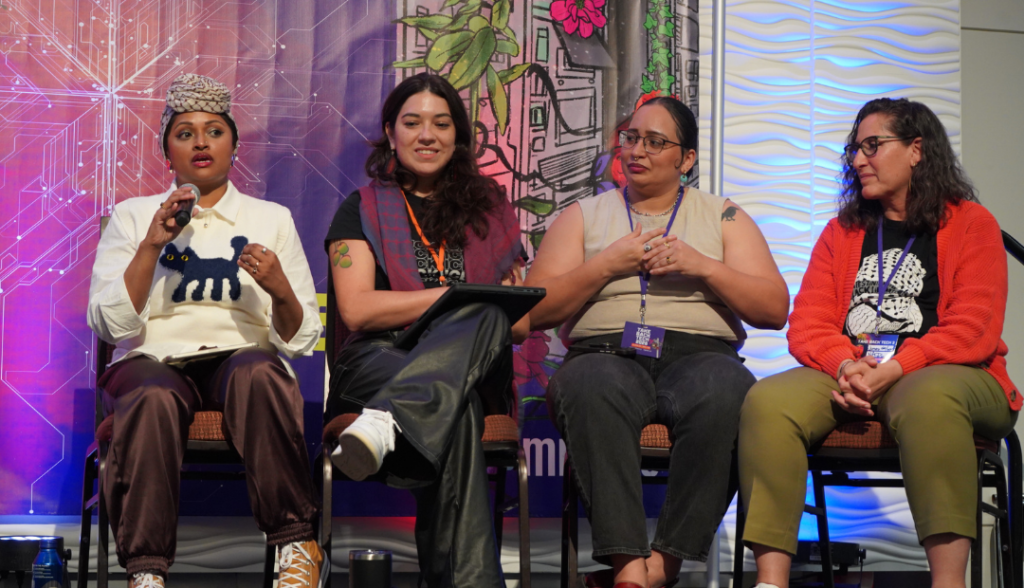
Then, we transitioned into our “The Race for Our Future” panel featuring frontline organizers KeShaun Pearson (Memphis Communities Against Pollution), Jorge Lopez (Movimiento Socioambiental Comunitario por el Agua y el Territorio), Gina Mangham (Renew DeKalb) and KD Minor (Alliance for Affordable Energy). Together, they broke down their fight back against data center expansions from Memphis to Chile and how Big Tech’s AI race is devastating our communities, polluting our neighborhoods, and harming our environment– all while driving up our utility bills.


But we know that we have the power, the numbers, and the energy to win. It’s like KD shared about data centers
[This work] is actually not really siloed, y’all. It’s just so much happening at one time that it feels that way, and that’s by design. That’s by design – they are trying to overwhelm us. But clearly they’re not doing a good enough job.
KD Minor, on data centers
Friday night wrapped up with powerful energy and connections as folks greeted each other, exchanged stories, and found common ground in their shared struggles and wins back home.
Saturday, April 18th – Day 2
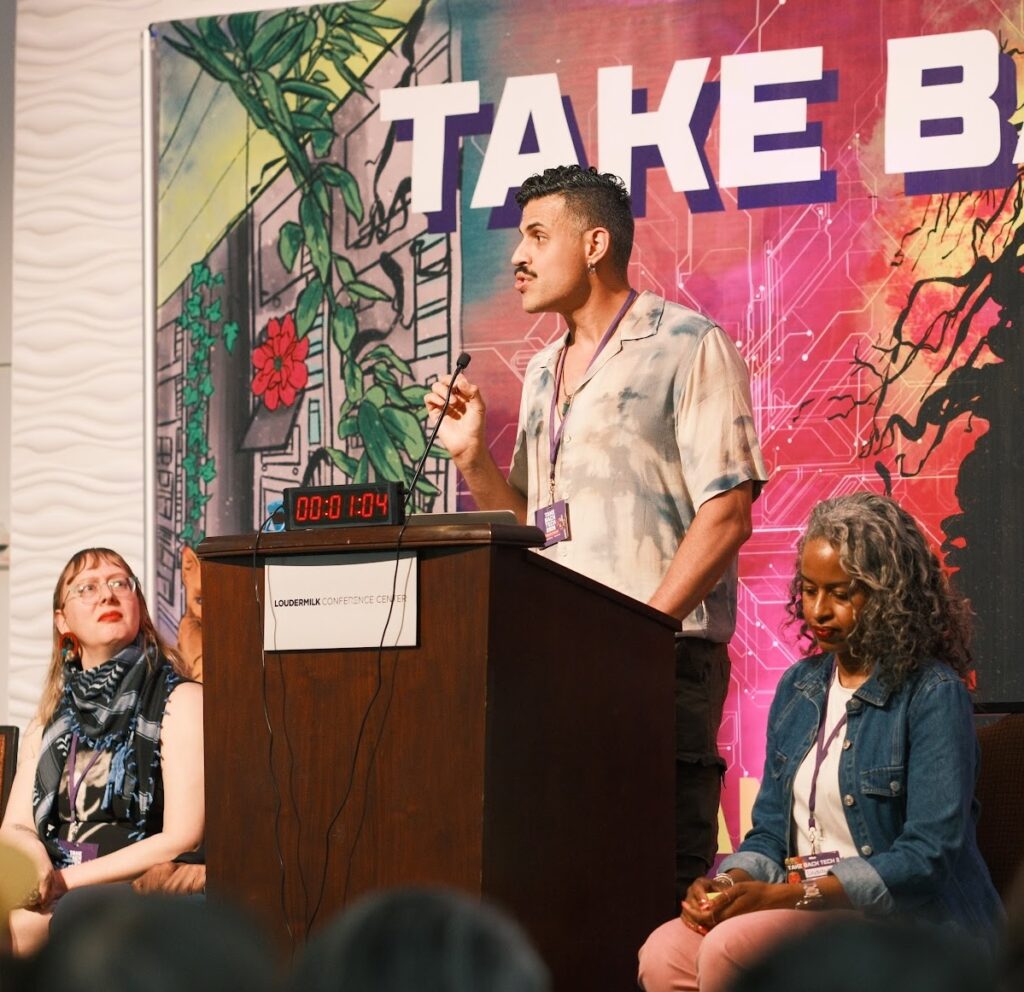
On Saturday, we gathered again at the Loudermilk Conference Center for a packed day of plenaries, workshops, and building collective power. The morning began with our “TechnoFachos: How Tech Power Became State Power” plenary, moderated by movement strategist Ash-Lee Henderson and featuring Marisa Franco (Mijente), Dr. Safiya Noble (Center for Race and Digital Justice), and Gil Durán (Nerd Reich Podcast). This panel peeled back the curtain on how Big Tech has fused with state power, feeding off the anxiety and anger of people who are tired of the status quo and asking “¿Quién me robó el futuro?”.
We can see clearly that the ones stealing our futures are doing so for their own profit and gain. The conversation covered how the technologies being deployed against us are built for domination and extraction, and how it’s on us to step up and resist. From organizers to academics to media makers — we all have a role to play in taking down these TechnoFachos.

After our plenary, the morning workshops kicked off, focused on equipping participants with the tools, strategies, and grounding needed to confront Big Tech’s takeover in their communities. Participants dove into sessions like:
- Building Tech Worker Power Against Technofascism — from Gaza to Minneapolis
- Purge Palantir – A Campaign Strategy Workshop on Fighting the Surveillance Giant
- Say What?: Narrative Listening Against Big Tech
- Fighting Tech Enabled Genocide Through a Strong Inside/Outside Game


Joy and Empowerment as Resistance
After breaking for lunch, participants gathered for a mid-day grounding led by Egun Omode, a West African dance, drum, percussionists, and Yoruba folklore performing arts collective.

We kept the energy going with afternoon workshops that got real about how tech violence fuels the disasters we face today, and how we fight back. The second half of our day featured workshops like:
- Who’s Behind ICE: The Militarized Police State Driving Tech-Fueled Authoritarianism
- The Deadly Tech Exchange: How tech companies are fueling genocide and ICE violence, from Gaza to Detroit to New Orleans
- If You’re Fighting Data Centers, This Room is For You
- Get the Flock Out: Case Studies and a Strategy Clinic on Fighting

The AI Question: A Movement Debate
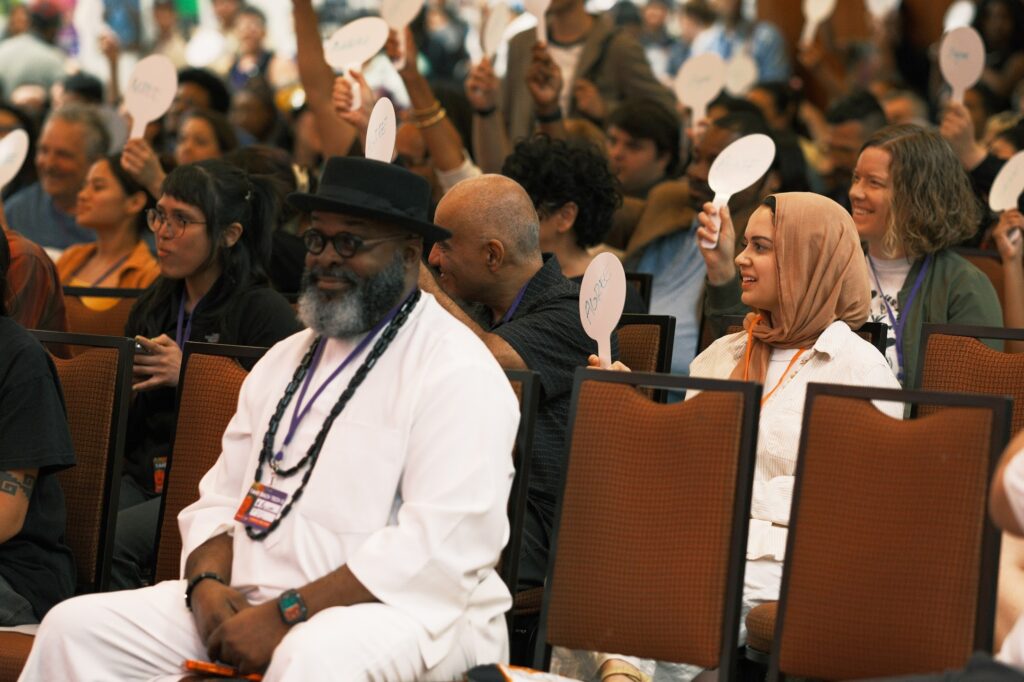
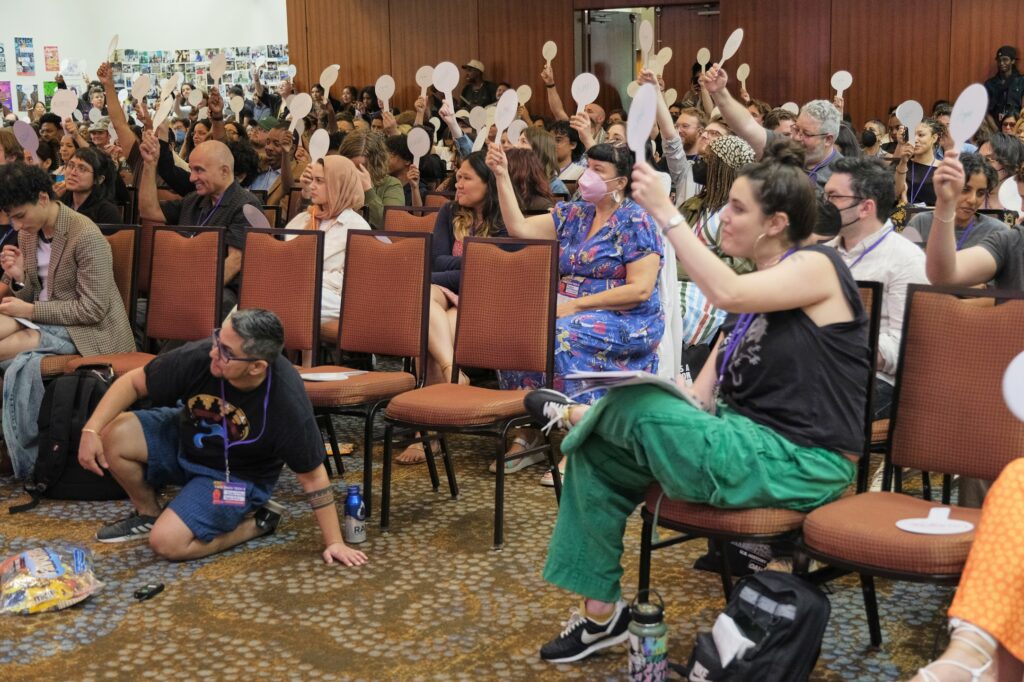
As we came back at the end of the day, we closed with “The AI Question: A Movement Debate”, where organizers on both sides wrestled with one of the biggest questions of our time: can AI really be reclaimed for people power, or should we disengage/abolish it entirely? We were joined by timekeeper Lindsay Harper and speakers Aasim Shabazz, Adrian Reyna Chavoya, Sasha Constanza Shock, Josue Guillen, and Janet Vertesi facing off against Sarah Hamid, Edith Romero, Vero Moreno, and Jumana Musa.

The room was charged with energy and camaraderie as the debaters exchanged ideas and perspectives. Some spoke to the difference between AI as an industry and AI as a tool. Others pointed out how, no matter any benefits, the influence of Big Tech and for-profit actors leads to corruption. Everyone collectively grappled with the future of AI in our movements and what a just path forward can look like.
We ended our second day together at the historic Curb Market (also known as the Sweet Auburn Municipal Market), where participants came together for music, games, and to keep building community with each other. Fellow conference attendees showcased their work alongside Atlanta vendors offering art, handmade goods, and other must-haves.
It was a powerful way to spend time together outside of our meeting spaces– sharing good bites, experiencing the heart of Atlanta, and building relationships with compas old and new rooted in joy and connection.
Sunday, April 19th – Day 3
Our final day began with our final round of workshops. The sessions dove deeper into how individuals can expand community knowledge and organizations
- NoTech for ICE Strategy Session
- Alternative, Autonomous, Communications – The Portable Network Kit (PNK)
- Rewriting the AI Narrative: From Paralysis Towards Radical Imagination
- Building Worker Power Against the Tech Oligarchy
We closed with our last plenary of the weekend, “The Story They’re Selling (And What We’re Building Instead)”, featuring Justin Hendrix (Tech Policy Press), Andre Brock (Georgia Tech University), Ariella Steinhorn (Hard Reset) and Cayden Mak (Block and Build Podcast). Panelists dismantled Big Tech’s false narratives and lifted up the work already happening on the ground to fight back and create systems that actually focus on centering community care and liberation.

As folks headed home, we ended the day with a special offering for compas still with us in Atlanta– a private screening of The Ghost in the Machine, a Sundance film diving deeper into how the roots of machine learning have paved the way for the systems of abuse we’re up against now. Director Valerie Veatch joined us for an interactive Q&A, where participants were encouraged to engage in conversation about the film’s lessons and their own work back home.

Making Our Demands Loud and Clear
This year’s Take Back Tech broke records. We brought together over 550 participants, with another 120+ on the waitlist. Every single compa who joined us was eager to be in the room, strategizing and building alongside other compas in our shared movement. The urgency of our political moment echoed across every single plenary, workshop, and conversation. From AI-powered surveillance that fuels deportations across the country, to data centers displacing our neighbors, the ever-growing threat of the tech oligarchy underscores exactly why our fight is more critical than ever.
Hundreds of participants, from big cities to rural communities, left feeling inspired and ready to use the strategies, tools, and lessons learned back to our organizing spaces and inform our local fights.


Our Present and Future Tech Wins
Techno-fascists continue to exploit our data, displace our people, destroy our ecosystem, and profit off of the harm they cause. We must continue to step up, fight back, and defend our communities. We are building toward a liberated future that serves us and centers tech justice for all.
We’ve seen the power of our collective resistance. In total “$64 billion of data center projects have been blocked or delayed amid local opposition”, according to Data Center Watch. Here are a few we’ve tracked:
- Fermi America CEO/co-founder steps down amid pressure
- St. Joseph County Council (Indiana) denies land rezoning for data center
- Data Center blocked in Tucson, Arizona
- Purge Palantir Campaign Actions
Together, we continue to show that the fight for tech justice is rooted in our people, our communities, and the collective power we build when we come together. That’s what Take Back Tech is all about.


Note of Thanks
As we reflect on this powerful and moving weekend together, we want to extend our deepest gratitude to everyone who made it possible. From our welcomers, grounders and performers, who helped keep us centered, to the Loudermilk staff who kept us fed and made sure we had the space to gather, to the dozens who contributed to our Solidarity Fund and helped make this convening accessible– your support powered so many of the vital conversations we had, relationships we built, and organizing we’ll continue. A special thanks as well to the Ghost in the Machine team and to director Valerie Veatch for joining us in dialogue.